The Power Of Perspective
A fine sense of judgement, superb interpersonal skills and well-tuned antennae are three of the defining characteristics of high performing leaders. Many things underpin and enrich these characteristics. Not least the power of a broader and deeper perspective to boost the quality of decision making, help us spot danger, maximise the probability of successful implementation, engage others and enable us to have a happier and less stressful time.
Instinct and perspective allow us to know where we and others are, as well as understand the context and terrain. And, as for owls, they can help us to combine a sharp focus on what we want to achieve with the ability to horizon scan and to be aware of opportunities and threats that others may miss. They can also help to mitigate or compensate for weakness in other areas.
An owl’s exceptionally mobile neck more than compensates for immobile eyes. Allowing their heads to rotate up to 270 degrees and enabling them to pinpoint prey with precision. Owls are also far-sighted, seeing things more clearly at a distance. They also bob their heads up and down to have multiple visions of an object. Interestingly, characteristics adopted in many of the increasingly sophisticated robots used in automated manufacturing processes.
So, how can we be owl-like and benefit from increased perspective without breaking our necks? What exactly are these benefits in a decision-making and leadership context? How do we manage to get alignment when we have different perspectives and how might we develop our ability to have a broader and deeper perspective?
Benefits:
According to various AI sources, five common benefits arise from having a broader and deeper perspective:
● Improved problem-solving and creativity: Thinking from different perspectives can prompt deeper, more sophisticated thinking. Resulting in greater creativity and better outcomes.
● Better decision-making: Understanding the "bigger picture" enables more effective prioritisation and objective setting. It can also help in balancing short- and long-term benefits and balancing the needs of different stakeholders.
● Enhanced cooperation and collaboration: Gaining the perspectives of different people within a group can help foster better cooperation and coordination enabling members to understand and take account of each other's intentions and viewpoints. It may also reduce the risk of dependence upon a single perceived "expert", whether they are or aren’t a real expert.
● Reduced negative biases: Perspective can help you question unhelpful assumptions and reframe situations to see possibilities rather than limitations. It may also prevent a "negative filter" caused by stress and help us to put things in context and assess their true significance.
● Emotional balance and regulation: Stepping back from stressful or negative situations can make it easier to manage our emotions, to respond rather than react and to avoid being overwhelmed. It can also lead to greater enjoyment and a more relaxed state, particularly in high-pressure situations.
A good list, to which I would add another five:
● Knowing where we and others are on an issue before we decide.
● Greater buy-in for implementing decisions.
● Better preparedness to communicate and to deal with objections when decisions aren’t in the interests of all stakeholders.
● Increased self-awareness and ability to adapt our own views because of those of others.
● Increased legitimacy for the decision makers.
We must also be conscious of the risks in aiming to broaden and deepen our perspectives. These include:
● Procrastination and failure to seize opportunities quickly enough.
● Trying to please everyone and making sub-optimal decisions.
● Managing expectations. The joy of inclusion can quickly be replaced with frustration if those whose perspectives are sought end up feeling that: “You asked me what I thought and then ignored it”.
Knowing where we and others are:
Gary Goodenough, Head of the UK and Ireland Region for SAP Concur Enterprise, believes lack of visibility is the biggest risk to businesses.
“We’re in such a fast-moving world with profound volatility in key variables as well as perspectives on the outlook. So, it is even more vital to have the data to help us know exactly where we are, and where we are likely to be, given current commitments and our expected trajectory.
“We’re seeing increasing demand for our audit capabilities as businesses need greater insight into their finances to make agile decisions.”
On top of having the data, we need to be able to differentiate between facts and interpretations, to listen to what people think as well as what they say and to take the time to understand the emotions behind viewpoints. As well as creating the right environment including psychological safety so that people feel free to express different perspectives, to challenge and to admit mistakes before, during or after meetings, makes this easier.
Telling people that it is a safe environment isn’t enough. In the “Boards” book, I referred to movie mogul Sam Goldywn’s quote “I want you all to tell me what you think, even if it costs you your job”. Psychological safety has to be real.
We must also remember that we and others don’t always act in our own best interests. For all sorts of reasons, including poorly thought through perspectives, because of the influence of the eloquent but wrong or because we project misguided views onto others and don’t hear what they say.
It helps a great deal to be actively open-minded and to be an active listener. Open-minded people are prepared to change their view if new information is presented to them. Whereas the actively open-minded go further. When a decision is coming up, they won’t just rely upon what is presented to them but will seek out additional information and have their antennae up for relevant information to calibrate what they will be presented with.
These are all especially helpful things when Chairing and trying to ensure that we not only make the right decision, but that it has the commitment and buy-in as well as the resources and relationships necessary for that decision to be successfully implemented.
Developing a broader or deeper perspective:
The Socratic ladder is an enduring approach to broadening or deepening our perspective. Essentially, it simply suggests that before a decision or when we are likely to be answering challenges to our thinking or proposals, that we prepare questions under the following headings:
● For clarification.
● To probe assumptions.
● To probe reasons and evidence.
● About viewpoints and perspectives.
● To probe implications and consequences.
● About the question itself.
A good discipline for developing critical thinking.
In calibrating views that we or others have, we need to be aware that we don't always see or hear the same thing as others. Testing understanding and what people have heard or will take away from a conversation is therefore useful.
A read of the late Daniel Kahneman’s brilliant book “Thinking fast and slow” can also help us bust inherent anchoring, confirmatory, mirroring, recency and other common biases. All things which can obscure our view and cloud our judgement. His other book “Noise”, co-authored with Oliver Sibony and Cass R.Sunstein, looks at the influence of noise in decisions and how to avoid flaws in judgment arising from it.
Tone, body language and the impact of first impressions all influence our ability to calibrate. Amongst many things, Robert Sapolsky’s fascinating book “Behave” explores how first impressions are often formed in a fraction of a second at a subconscious, automatic level. These rapid neural responses can trigger fear or hostility toward perceived “others" before the logical part of the brain has a chance to process the information. In a time-pressured world we may not always find it easy to take the time to calibrate our views.
The use of AI and its strength in synthesising multiple sources of information has the power to boost or reduce our ability to calibrate. AI’s efficiency and short snappy summaries are incredible. Yet we aren’t always aware of the root sources of information in them or of the weighting of views and information. At this stage, AI usually summarises the information that is out there and often, sadly, a small number of extreme or negative views can sometimes distort the balance.
Incidentally, one of the many quotes attributed to Socrates which is also relevant, is that “It’s easier to win an argument than to make the right decision”. At some point you need to synthesise views and make a call. If you are the Chair, the responsibility falls to you to enable the Board to agree on the right way forward with as much alignment as possible.
Achieving alignment from different perspectives
An image from “Boards” on alignment that I often use in leadership and board training is:
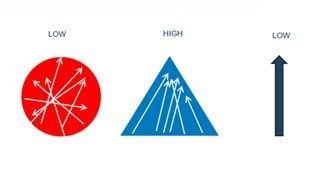
From individual conversations or first observations of board meetings, you can generally tell whether a board or leadership team are at the disorganised rabble or autocratic state end of the spectrum, somewhere in between or oscillating between either end. The paragons in the triangular middle are able to achieve this by having an aligned vision and purpose, enough diversity of thought to spare them from GroupThink and a good way of managing different views and conflict. An effective Chair being a key driver and enabler of their ability to achieve this.
Three useful questions to ask each member of the board or leadership team to help reveal the level of alignment are:
● What do you think the point of the organisation is?
● What do you think are the top three priorities for the organisation in the year ahead?
● How would you describe the relationship between the board and the executive, the Chair and the Chief Executive and the Chief Executive and the Chief Financial Officer?
On the “Top 3” question, if they all have the same 3, then beware you may be in GroupThink territory. If they all have a common 2 and about half of them pick another one and half different ones, then you have a reasonable level of diversity of thought. One board I was helping had 29 from 7 directors. Apart from an issue in the adding up department, they clearly had very different views on what’s important and hadn’t discussed priorities, or had and couldn’t agree.
It’s obviously better to take the time to make the right decision than to make the wrong one quickly thanks to GroupThink. But how might we minimise the time we take and still retain the value of different perspectives and the process it involves getting them?
The right culture, skilful Chairing and the use of the aligning magnet of what is in the best interests of the organisation and its stakeholders are important contributors to achieving the right balance. Smart framing of a decision discussion, encouraging constructive challenge and everyone involved putting the work in beforehand helps enormously.
The bottom line:
In an increasingly polarised and noisy world, a broader and deeper perspective boosts the power of our ability to make the right choices, individually or collectively. We need to be conscious of the need and put the work into having a broader and deeper perspective. Then, like owls, overcome inhibitors to have a clear view of where we are and where we’re going, as well as understanding what might get in our way.
Patrick Dunne OBE
Experienced Chair. Author of the award-winning book “Boards” and co-author of “Five Generations at Work: How We Win Together, For Good”.
This article is sponsored by SAP Concur – industry-leading technology that automates travel, expense and invoice spend processes. The fee will be donated to Warwick in Africa which works with partner schools, located in economically disadvantaged areas in Ghana and South Africa.